Everything you need to know about eco-friendly refill packaging
In 2018, the European Union voted to ban single-use plastics by 2021 – an important step in the right direction towards reducing the amount of waste floating in our oceans. Only 9% of the plastic we use today is recycled, and unfortunately, a large portion of the remaining 91% risks ending up in the oceans. In addition to plastic destroying wonderfully beautiful, untouched beaches and coral reefs around the world, it also harms marine life. Animals mistake colorful plastic packaging for food or get entangled in the material. Increased environmental awareness makes the transition to more environmentally friendly packaging – such as refillable soap bottles that don't need to be discarded when empty – a natural choice.

L'OCCITANE HAS BEEN SELLING REFILLS SINCE 2008
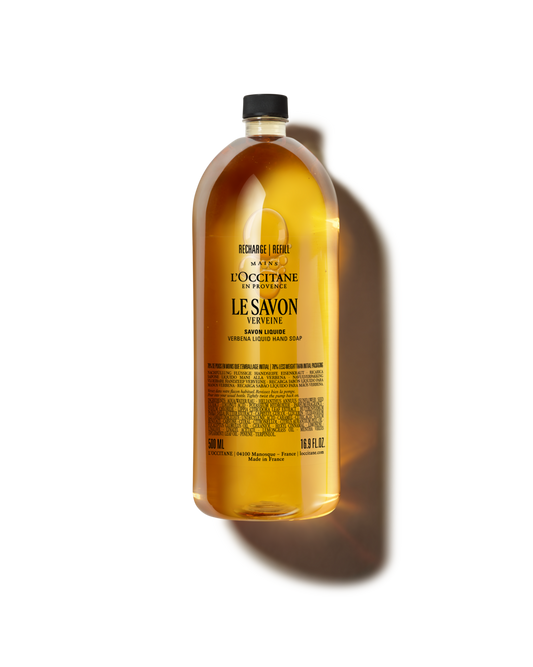
For a lomg time, more and more companies have reduced their use of plastic, and we are proud to say that we have always been at the forefront of this movement. It in 2008 that we launched our first environmentally friendly refill, our Shea Verbena Hands & Body Liquid Soap Refill, which is enriched with softening shea butter and has a lovely, citrusy verbena scent.

ECO-FRIENDLY REFILL PACKS SAVE THE ENVIRONMENT
Thanks to our environmentally friendly refill packaging, we used 124 tonnes less plastic last year – this is equivalent to an entire blue whale! This amount of plastic is about twice as heavy as a space shuttle – NASA's Endeavour weighed 71 tonnes. Each eco-friendly refill pack is equivalent to approximately 50 plastic cups, 300 straws, and 3,000 cotton swabs – plastic that would otherwise risk ending up in the oceans.
BESTSELLER
-
Nytt utseende, samma innehåll
Regular price Refill 500 ml 319 kr Regular price - % Sale price Refill 500 ml 319 kr
-
Nyhet
Regular price Refill 500 ml 349 kr Regular price - % Sale price Refill 500 ml 349 kr
-
Nyhet
Regular price Refill 500 ml 349 kr Regular price - % Sale price Refill 500 ml 349 kr
-
Nytt utseende – förbättrad doft
Regular price Refill 200 ml 439 kr Regular price - % Sale price Refill 200 ml 439 kr
-
Bestseller
Regular price Refill 100 ml 439 kr Regular price - % Sale price Refill 100 ml 439 kr
-
Nytt utseende, samma innehåll
Regular price Refill 200 ml 549 kr Regular price - % Sale price Refill 200 ml 549 kr
-
Regular price Refill 500 ml 419 kr Regular price - % Sale price Refill 500 ml 419 kr
-
Nyhet
Regular price Refill 70 g 199 kr Regular price - % Sale price Refill 70 g 199 kr
-
Nyhet
Regular price Refill 500 ml 349 kr Regular price - % Sale price Refill 500 ml 349 kr
-
Nyhet
Regular price Refill 500 ml 349 kr Regular price - % Sale price Refill 500 ml 349 kr
-
Regular price Refill 200 ml 699 kr Regular price - % Sale price Refill 200 ml 699 kr